
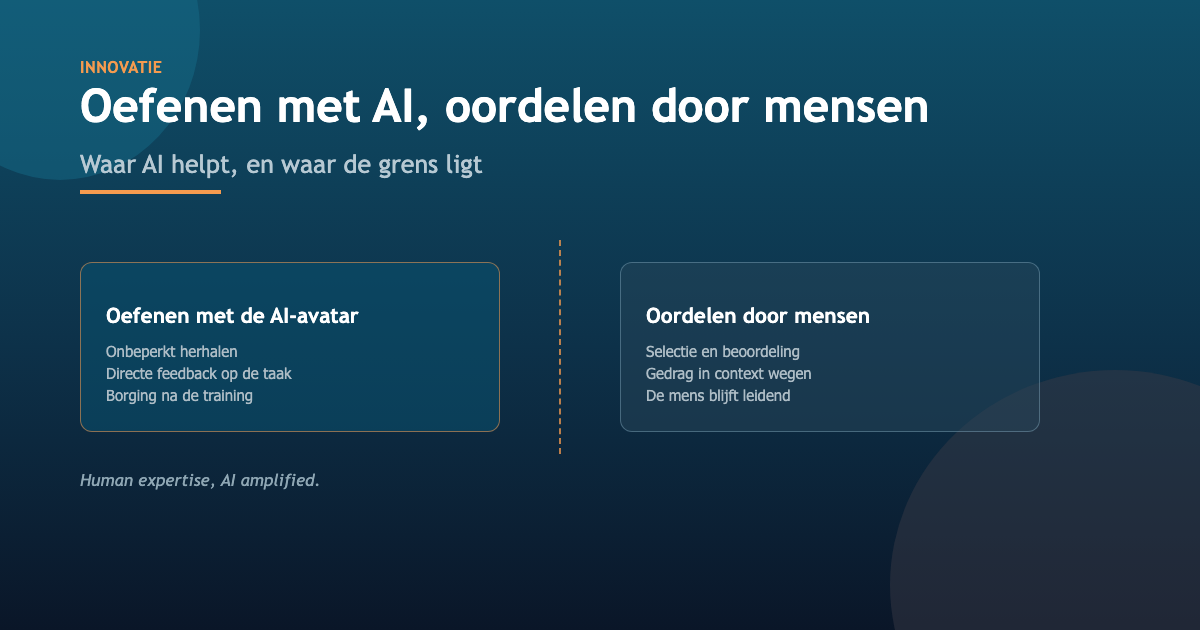
A strong training sets behaviour in motion. Then the hard part begins: holding on to that new behaviour once the daily grind returns. That is exactly where AI can mean a lot. And that is exactly where it pays to be clear about the role AI gets.
Why practice after the training makes the difference
Skills you do not use fade. A meta-analysis of 53 studies on the loss of trained skills shows that almost nothing is lost immediately after a training. After a year without practice, the loss is substantial. Cognitive tasks turned out to be more susceptible than physical ones (Arthur et al., 1998). Applying a conversation structure or holding your ground in a negotiation falls into that first category.
Commercial teams will recognise this. The training was good, the technique was there, and a few months later everyone is running the conversation the way they used to. If you want new behaviour to stick, you have to keep practising it.
What AI does well here
Practice takes time, a practice partner and a safe setting. That makes it scarce. An AI avatar removes those barriers. You hold a client or negotiation conversation whenever it suits you, as often as you like, without a real deal at stake. Straight after the conversation you get feedback.
That feedback does have to be good. A classic meta-analysis of more than 600 effects shows that feedback improves performance on average, but that more than a third of feedback interventions actually made performance worse. The difference lies in where the feedback directs attention. Feedback on the task helps. Feedback that draws attention to the person themselves backfires (Kluger & DeNisi, 1996).
That is why the avatar's feedback focuses on the conversation itself: your structure, your questions, your opening position, and what you can sharpen next time.
Where judgement belongs with people
There is also a line, and we draw it deliberately. The avatar is built for learning. Judging a person belongs with people: whether someone is suitable for a role, ready for a promotion or better suited elsewhere.
There are two reasons. The first is about substance. Anyone who selects or assesses people wants to see behaviour that was not scripted in advance, weighed by someone who knows the context. Our sister organisation AVOP, specialists in assessment, wrote about it: what predicts success in a role, now that candidates use AI?
The second reason is legal. The EU AI Act classifies AI systems that evaluate the performance and behaviour of employees as high risk. Strict requirements apply to those systems from 2 December 2027 (European Commission, 2026).
How we use the avatar
Every Zenith programme follows the same line: diagnosis, live training, embedding. The diagnosis avatar is a baseline measurement. It shows where the growth lies, so our consultants can focus the live training exactly there. We use the team dashboards to steer training and coaching. They are expressly not intended for assessing individual employees.
Human expertise, AI amplified. Our consultants set behaviour in motion, the avatar keeps it alive. The training is over, the development continues.
Curious what that looks like? See the Zenith AI avatar or get in touch for a demo.
Sources
- Arthur, W., Jr., Bennett, W., Jr., Stanush, P. L., & McNelly, T. L. (1998). Factors that influence skill decay and retention: A quantitative review and analysis. Human Performance, 11(1), 57-101. doi.org/10.1207/s15327043hup1101_3
- Kluger, A. N., & DeNisi, A. (1996). The effects of feedback interventions on performance: A historical review, a meta-analysis, and a preliminary feedback intervention theory. Psychological Bulletin, 119(2), 254-284. doi.org/10.1037/0033-2909.119.2.254
- European Commission (2026). AI Act: regulatory framework on AI. digital-strategy.ec.europa.eu
- Regulation (EU) 2024/1689 (AI Act), Annex III, point 4. eur-lex.europa.eu