
Everyone has a preferred style in negotiations. A way of responding that automatically surfaces the moment pressure increases. That instinctive reaction is not inherently good or bad, but it does determine the outcome. Those who know their own preferred behaviour can deploy it consciously or adjust it. Those who don't are driven by it without realising it.
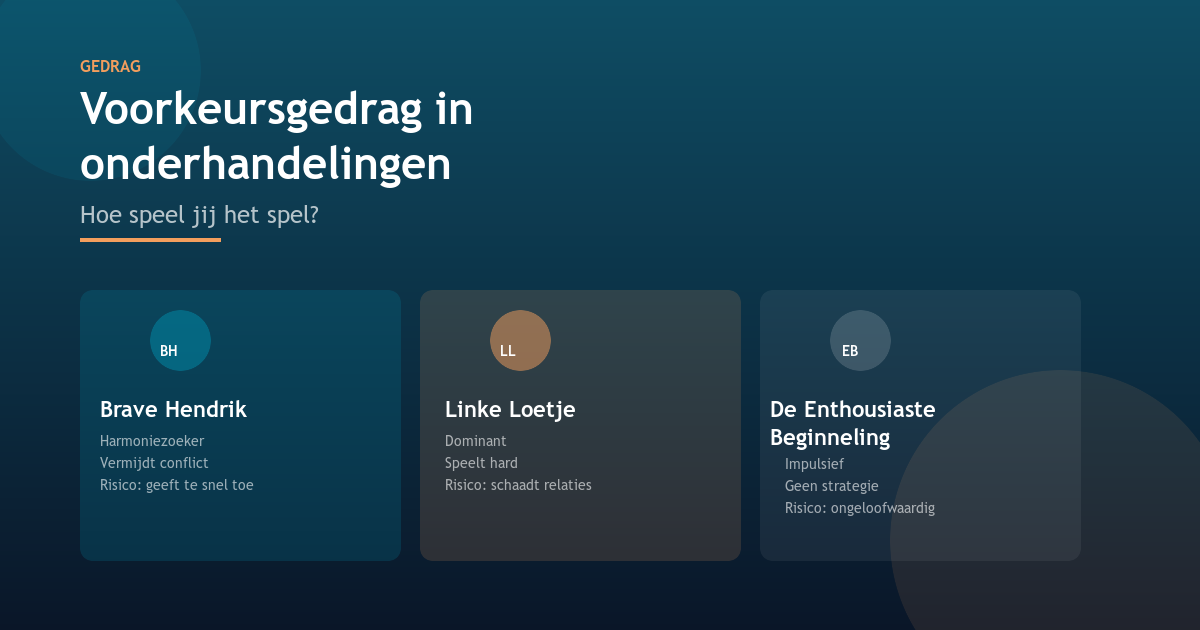
1. Brave Hendrik - The Harmony Seeker
Brave Hendrik wants to be liked above all else. Confrontation feels uncomfortable, so it is avoided. The focus is on the relationship, on showing understanding and on collaboration. That sounds sympathetic, but at the negotiating table it comes at a price.
The harmony seeker concedes too quickly. Not because the other party's argument is stronger, but because the tension feels unpleasant. The result is a deal that serves the other party more than yourself. Afterwards, a sense of dissatisfaction often lingers: the feeling that you could have achieved more had you been firmer.
The risk of this behaviour is structural value loss. Those who consistently concede too early train the other party to keep asking for more. The relationship you are trying to protect ultimately becomes a relationship of inequality.
Where is this behaviour effective? In long-term partnerships where building trust and relationship takes priority over maximising a single outcome. But even then, it must be a conscious choice, not an automatic reflex.
2. Linke Loetje - The Dominant Negotiator
Linke Loetje sees negotiation as a competition. There is a winner and a loser, and Linke Loetje wants to win. Cards are kept close to the chest, information is withheld strategically and the game is played hard.
This style often delivers strong results in the short term. The dominant negotiator claims value, applies pressure and forces concessions. But there is a downside. Relationships can be damaged. Partners feel manipulated or pressured, and over time look for alternatives.
The risk is isolation. Those who always win at the table eventually lose the partners who are willing to come to the table. In highly competitive markets this approach can work, provided you are aware of its limits and consequences.
3. The Enthusiastic Beginner
The enthusiastic beginner has no conscious strategy. Responses are impulsive, driven by whatever happens in the conversation. One moment there is compliance, the next unexpected firmness. The approach shifts constantly without any clear line running through it.
This lack of consistency undermines credibility. The other party does not know what to expect and loses confidence that there is a reliable counterpart on the other side of the table. The outcome is unpredictable and rarely optimal.
The risk of this behaviour goes beyond a bad deal. It damages your professional reputation. Negotiating partners remember how you behave under pressure, and that impression shapes how future conversations unfold.
Professional Negotiation Behaviour
The best negotiators do not fall into any of these three categories. They recognise all three styles, understand when each behaviour is functional and consciously switch between approaches depending on the situation.
Professional negotiators treat negotiation as a game. They take nothing personally and do not let emotions set the course. Their guiding principle is clear: hard on the content, soft on the relationship. They defend their interests with conviction, but always treat the other party with respect.
In practice, this means they remain emotionally independent. Pressure, frustration or provocation from the other party does not change their approach. They do not react impulsively but strategically. And they always seek the optimal deal rather than a win or a loss. A deal in which both parties find sufficient value to sustain the partnership.
Conclusion
Recognise your own preferred behaviour. Know when it serves you and when it limits you. And develop the ability to switch consciously between styles. That is not a trick, but a skill you can train. Those who master that skill have an advantage at every negotiating table.