
Most negotiators spend the majority of their energy on the conversation itself. They focus on arguments, tactics, and persuasion. But the reality is that eighty percent of a negotiation's outcome is determined by what you do before you sit down at the table. Preparation is not an optional step. It is the foundation on which every successful negotiation outcome rests.
1. Analyse the starting position
Every solid preparation begins with an honest analysis of the starting position. Ask yourself the critical questions before entering the conversation. What do I want to achieve? What are my strengths and where am I vulnerable? What does the other party likely want to achieve? Which arguments support my position and how strong are they? Where can I potentially concede without compromising my core interests?
This analysis forces you to look beyond your own perspective. By examining the situation from the other party's point of view as well, you uncover opportunities and risks you would otherwise miss. Many negotiators overestimate their own position or underestimate the other party's. A thorough analysis prevents both mistakes.
2. Define your negotiation bandwidth
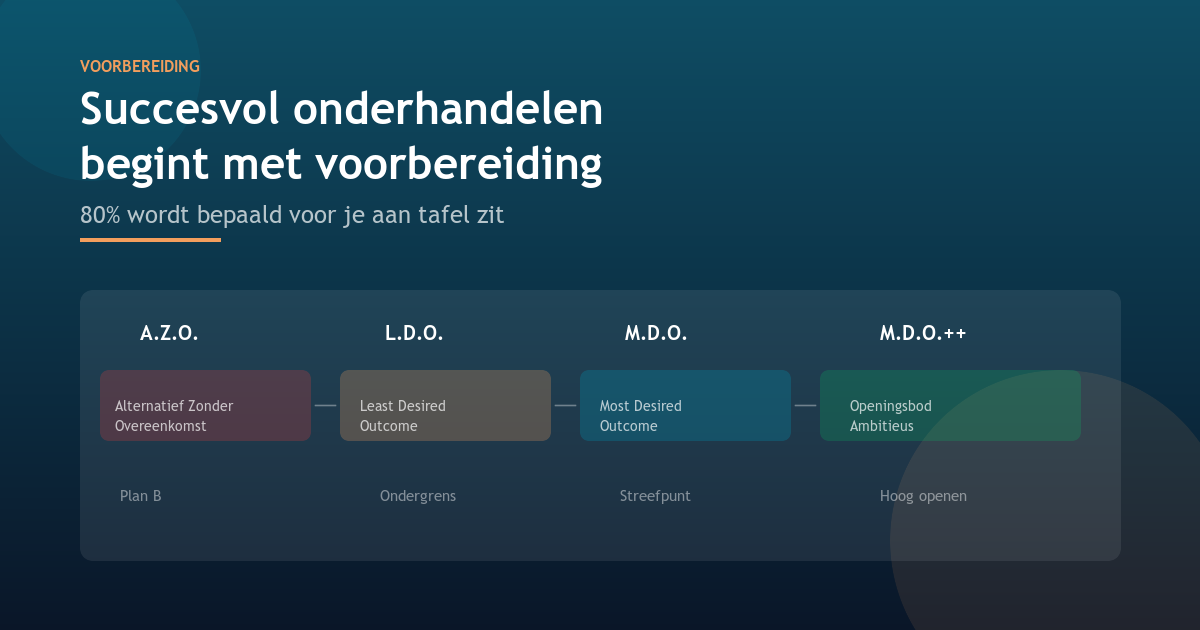
A professional negotiator never enters a conversation with just one number in mind. You need a bandwidth that gives you direction and flexibility. That bandwidth is built around four anchor points.
Your W.A.T.N.A. (Walk Away To No Agreement) is your plan B. What do you do if this negotiation does not lead to an agreement? The stronger your alternative, the more powerful your position. Your L.D.O. (Least Desired Outcome) is the absolute minimum you are willing to accept. Below that, you walk away. Your M.D.O. (Most Desired Outcome) is your target, the result you are aiming for. And your M.D.O.++ is your ambitious opening offer, higher than your target but still defensible.
A strong negotiator always opens with an M.D.O.++ that is ambitious yet defensible. This creates negotiating room and shapes the other party's expectations. Those who open too low give away money. Those who open too high without justification lose credibility.
3. Know your trading currency: primary and alternative currencies
Negotiating is rarely about price alone. Yet that is the point where many negotiations stall. The key to breaking a deadlock is trading currency: elements you can deploy to create or exchange value.
Primary currency covers the obvious variables: price, volume, and delivery terms. But the real gains are often found in alternative currencies. Think exclusivity agreements, contract duration, marketing support, payment terms, or flexibility in specifications.
Smart negotiators deliberately play with trading currency. They know in advance which concessions they can make that cost them relatively little but represent significant value to the other party. This makes it possible to give without losing and to gain without draining the other side.
4. Think like a lawyer
The final step in your preparation may be the most challenging: put yourself in the other party's shoes. Think like their lawyer. What arguments will they put forward? Where will they apply pressure? What are their alternatives if this deal falls through?
By thinking through the negotiation from the other party's perspective, you prepare yourself for their strategy. You can formulate counter-arguments, identify weaknesses in their position, and anticipate their responses. Anyone caught off guard at the negotiating table has not prepared thoroughly enough.
Conclusion
Strong negotiators win their deals in the preparation, not at the table. By analysing the starting position, defining a clear bandwidth, mapping out trading currency, and thinking like the other party, you enter every conversation with an advantage. The conversation itself then becomes the execution of a well-considered plan, not a leap into the unknown.