
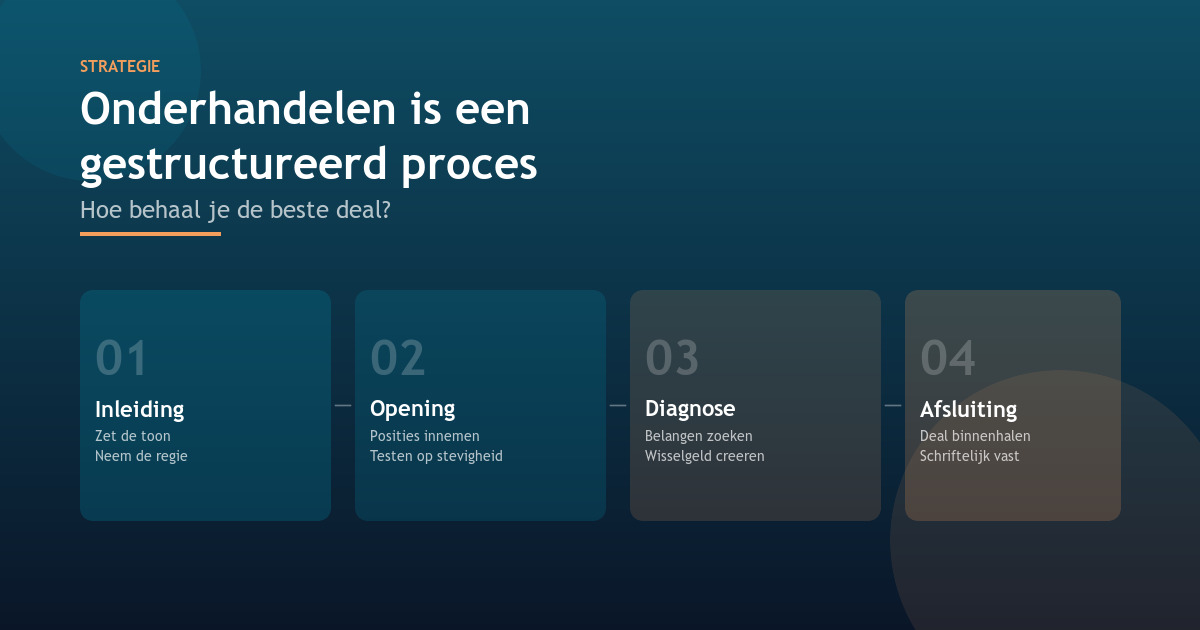
Many negotiators enter a conversation with a goal, but without a plan. They rely on experience, improvisation or persuasiveness. The results are inconsistent: sometimes it works, sometimes it doesn't, and afterwards it's unclear why. Professional negotiation requires structure. Not as a straitjacket, but as a compass that guides you through every phase of the conversation. The 4-step model provides that structure and gives you control over both the content and the behaviour at the table.
Step 1: The Introduction - Set the tone and take control
The introduction is the foundation of every negotiation. This is where you establish the atmosphere, the expectations and the agenda. Whoever masters the introduction controls the direction of the conversation.
Use the A.D.A. technique for this. Start with the Rationale: outline the context and explain why you are sitting at the table. Then formulate the Objective: what do you want to achieve in this conversation? Close with the Agenda: which topics will be covered and in what order?
The behaviour in this phase is calm and factual. Ensure convincing body language: open posture, eye contact, a steady voice. Manage expectations without overplaying your hand. The introduction is not the moment to take positions, but to lay a professional foundation on which the rest of the negotiation can build.
Step 2: The Opening - Taking positions and testing their firmness
After the introduction, the substantive game begins. In the opening, you put your starting position on the table. This is the moment to present your M.D.O.++: your ambitious yet defensible opening offer.
Don't be afraid to open high. Research consistently shows that negotiators who open ambitiously achieve better results. Repeat your key message three to four times in different words. Repetition strengthens your position and demonstrates that you are steadfast.
The behaviour in this phase is convincing and resolute. Use absolute language: "This is our position" rather than "We would appreciate it if..." Ensure your non-verbal communication is powerful. Hesitation in your body language undermines even the strongest argument. The opening is about credibility: the other party must believe that you mean what you say.
Step 3: Diagnosis - Exploring and creating trading currency
The diagnosis phase is where good negotiators distinguish themselves from average ones. Here the focus shifts from sending to receiving. You explore the interests, priorities and constraints of the other party.
Ask open questions such as: "What is most important to you in this deal?" or "Where are your biggest challenges?" Listen actively to the answers and look for trading currency. Trading currency is anything you can offer that costs you little but is valuable to the other party. Think of flexibility in delivery times, exclusivity agreements or additional services.
The behaviour in this phase is inquisitive and creative. Deliberately play with the pace of the conversation: slow down when you receive important information, speed up when you pass over less relevant topics. Use summaries regularly to check whether you understand the other party correctly and to maintain structure in the conversation.
Step 4: Closing - Securing the deal
The closing is the moment of truth. All previous steps lead to this point. This is where you bring the negotiation to a concrete result.
The principle is clear: nothing comes for free. Every concession you make is linked to a counter-concession. Have the other party agree to your proposal before you make further commitments. And always ensure a written confirmation of the agreements. Verbal agreements are vulnerable and regularly lead to misunderstandings afterwards.
The behaviour in this phase is empathetic and controlled. Deliberately slow down the pace. Rushing the closing leads to mistakes and missed opportunities. Create a positive final feeling: the other party should leave with the sense that a good agreement has been reached. This not only strengthens the current deal, but also the foundation for future negotiations.
Conclusion
Negotiation is not a talent you either have or don't have. It is a skill that can be learned and improved by applying structure. The 4-step model provides that structure: from setting the tone in the introduction, through taking positions and exploring interests, to securing the deal. Those who consciously work through these steps negotiate not on instinct, but on strength.