
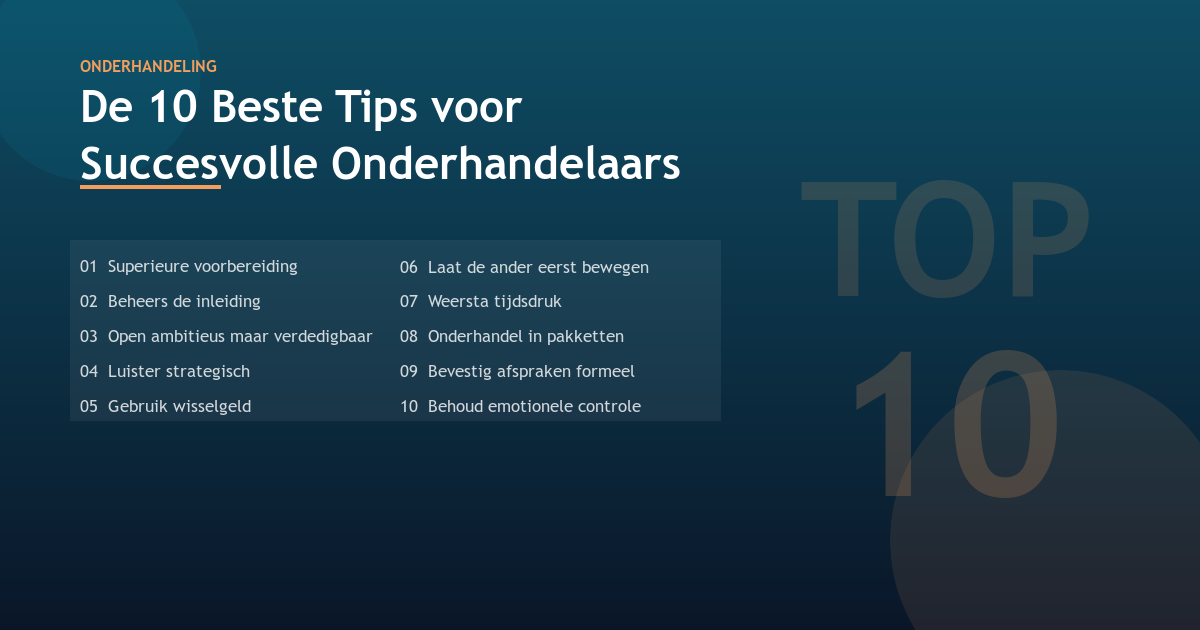
Negotiation is not an innate talent. It is a skill you can develop, sharpen and perfect. The best negotiators distinguish themselves not through aggression or bluffing, but through preparation, discipline and psychological insight. These ten tips form the foundation of effective negotiation.
1. Superior preparation
A good negotiation is won before it begins. Know your facts, your alternatives and your objectives. Know what you want to achieve, what you will minimally accept and where your breaking points lie. Research the position, interests and possible alternatives of the other party. The more you know, the fewer surprises you will encounter and the stronger your position at the table.
2. Control the opening
The first few minutes set the tone. Take the initiative by setting the agenda, establishing expectations and defining the structure of the conversation. Project authority by being well-prepared, professional and personable. Whoever controls the opening often controls the entire conversation.
3. Open ambitiously but defensibly
Your opening offer defines the playing field. An overly cautious opening eliminates your negotiating room before the conversation has even gained momentum. Open ambitiously, but ensure your position is defensible with arguments and data. An ambitious opening gives you room to move and signals to the other party that you are serious and well-prepared.
4. Listen strategically
Strong negotiators listen more than they talk. Listening is not a passive activity — it is a strategic instrument. By listening carefully, you uncover the true interests, concerns and priorities of the other party. Use strategic silences to prompt reflection and open questions to surface deeper information. Those who listen, learn. And those who learn, win.
5. Use trading variables
Do not negotiate on price alone. Identify items that cost you little but are valuable to the other party. Think about delivery times, payment terms, volume agreements, service levels or exclusivity clauses. Trading variables expand the negotiating space and make it possible to hold firm on price while showing flexibility in other areas.
6. Let the other party move first
Avoid premature concessions. The urge to give something away quickly in order to create goodwill is understandable but strategically unwise. Ask for a counter-offer before you make a move. Whoever moves first sets the benchmark for the rest of the negotiation. Let the other party reveal their position first and respond from there.
7. Resist time pressure
Time pressure is one of the most commonly used tactics in negotiations. Deadlines, expiry dates and the suggestion that an offer will soon disappear — all designed to force you into hasty decisions. Deliberately take time to think. Slow the conversation down when you feel the pressure mounting. A good deal can withstand a night's sleep.
8. Negotiate in packages
Avoid the trap of negotiating point by point. When each item is discussed separately, you lose the overview and the ability to trade. Bundle items into an overall deal and present them as a coherent package. This gives you greater flexibility and prevents the other party from applying maximum pressure on each individual point.
9. Confirm agreements formally
A deal is only a deal when it is in writing. Verbal agreements are vulnerable to misunderstandings, forgetfulness and creative reinterpretation. At the end of each conversation, summarise the agreements reached and put them in writing. Send a confirmation by email the same day. This prevents disputes afterwards and protects both parties.
10. Maintain emotional control
Negotiation stirs emotions. Frustration when the other party will not move, excitement when the deal is within reach, irritation at unreasonable demands. The best negotiators recognise these emotions but do not let them take the wheel. Respond deliberately rather than impulsively. Take a break when you feel emotions are threatening to take over. Emotional control is not the suppression of feelings, but the conscious choice of your response.
In closing
These ten tips are not secret formulas but proven principles applicable in any negotiation. They require awareness, practice and discipline. The negotiator who makes these principles second nature will find that conversations flow more smoothly, results improve and relationships grow stronger.