
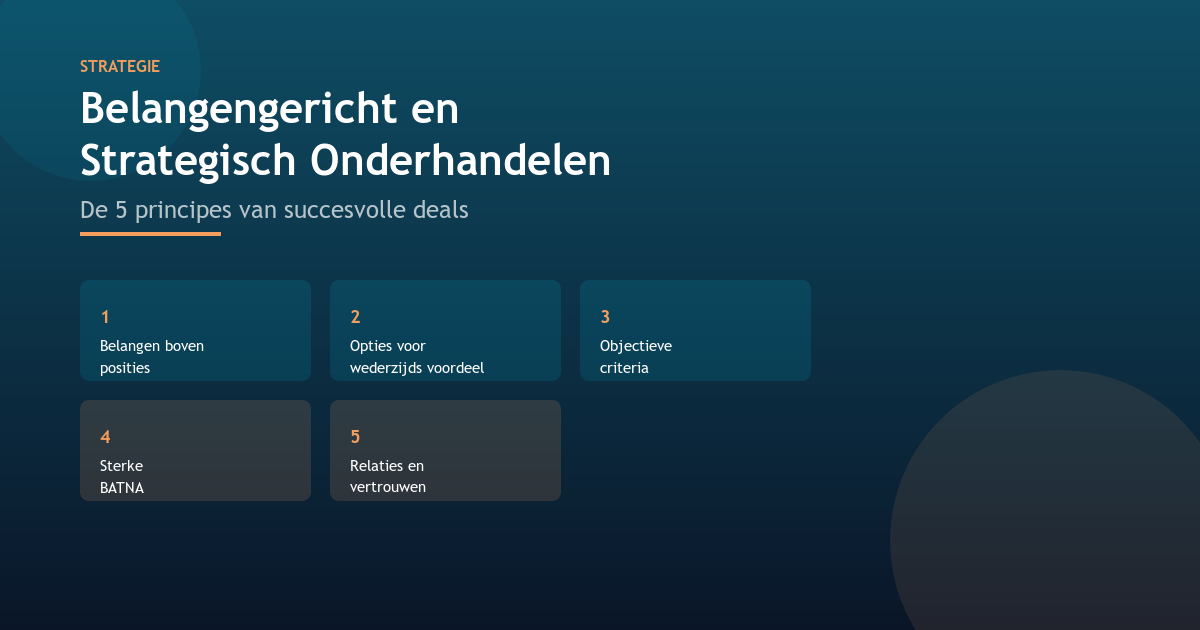
The most common mistake in negotiations is clinging to positions. Two parties take a stance and try to get the other to move. The result is a battle of attrition in which no one comes out optimally. Interest-based and strategic negotiation offers an alternative: an approach that focuses on the underlying interests of all parties and creates value from there. These five principles form the core of that approach.
1. Focus on interests, not positions
A position is what someone says they want. An interest is why they want it. The difference is crucial. Two department managers who both want the same meeting room (position) may have entirely different interests: one needs daylight for a presentation, the other is looking for quiet for a strategic consultation. Once the interests are clear, solutions emerge that work for both parties. Therefore, ask not only what the other party wants, but above all why. Actively seek out shared interests. They form the foundation on which lasting agreements are built.
2. Create options for mutual gain
Negotiation does not have to be a zero-sum game. The pie can be made larger before it is divided. Brainstorm in advance about possible options that add value for the other party but cost you relatively little. A supplier who offers flexible payment terms gives something away that costs them little but is highly valuable to the customer. A customer who offers volume guarantees gives the supplier certainty that is worth more than a higher unit price. Creative thinking about value exchange distinguishes strategic negotiators from negotiators who focus solely on price.
3. Use objective criteria
When interests are opposed and creative options are insufficient, objective criteria serve as the arbiter. Support your position with data, market standards, benchmarks and independent sources. This prevents the negotiation from degenerating into a power struggle in which the strongest party wins. Objective criteria shift the conversation from "I want" to "the market demonstrates that". That is not only more effective, it is also perceived as fairer by the other party, which benefits the relationship.
4. Develop a strong BATNA
Your BATNA (Best Alternative to a Negotiated Agreement) is your most powerful negotiating weapon. It is the best alternative you have if the current negotiation does not lead to an agreement. The stronger your BATNA, the more confidence you can show at the table. Analyse your alternatives in advance and invest in them. Avoid dependence on a single opportunity or a single client. A negotiator without a BATNA is a negotiator who is forced to accept every deal, regardless of the terms. That is not negotiating. That is capitulating.
5. Build relationships and trust
The best deals are not made in spite of the relationship, but because of it. Honesty, transparency and professionalism are not soft skills — they are strategic choices that directly influence the quality of the outcome. A party that trusts you shares more information, is more flexible and actively thinks along towards solutions. Moreover, always consider the long-term impact. A deal that delivers maximum short-term gain but damages the relationship is rarely the best deal. Reputation takes years to build and minutes to lose.
In closing
Interest-based and strategic negotiation is not an idealistic concept. It is a proven method that in practice leads to better outcomes for all parties involved. By focusing on interests, creatively developing options, using objective criteria, building a strong BATNA and nurturing relationships, you create deals that endure and from which both parties emerge better off.